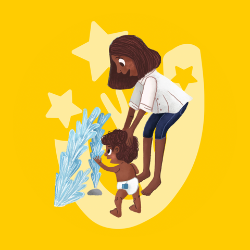
You know that feeling when a child walks into a room and immediately spots something that looks like their world? A familiar hairstyle or haircolor, a front stoop that looks like home, a splash pad that feels like the one they walk to every day. Their shoulders drop. Their curiosity turns on. They settle in.
That’s belonging.
Recently, I read an excellent article previewing a new working paper from the Center on the Developing Child at Harvard about “mattering” in early childhood. The authors describe mattering as the deep sense that we are valued and have value to add to the world—that our presence and contributions truly count. Center on the Developing Child at Harvard University
They distinguish it from “belonging,” which they describe as whether or not we fit into a community or setting. I was fascinated by that academic distinction and appreciated the chance to reflect on what it means for our work at Upbounders®—a company that features Belonging Begins with Play® on many of its boxes.
Over the years, we’ve been challenged—often and from every angle—on what “belonging” really means and what truly matters when identifying toys that are constructive, joyful, and developmentally meaningful for kids. Those questions have pushed us, in the best way, to clarify not only what we make, but why we make it.
So, what’s the deal with belonging? And does it matter?
As both a parent and the founder of a toy company, I believe the answer is yes—and that belonging is one of the earliest places where mattering can take root.

Belonging & Mattering: Interconnected principles in the story of play
The Harvard paper makes an important clarifying point: you can technically belong to a family, a classroom, or a team and still not feel like you matter there. Mattering goes deeper—it’s about feeling valued and knowing what you do makes a difference. Center on the Developing Child at Harvard University
That distinction is compelling. In early childhood, especially from birth to age three, it’s important to keep belonging in the conversation, as belonging and mattering are tightly woven together.
ZERO TO THREE, a leading organization in early childhood development, has published extensively about how a child’s sense of self and belonging develops in the context of relationships and everyday environments. They emphasize that:
Young children build their sense of who they are through the stories, labels, and memories adults share with them.
Their sense of self is shaped by the groups they’re part of family, classroom, community - and those groups help answer the question, “Where do I fit?” ZERO TO THREE
A positive sense of self and belonging is described as foundational for children’s current and future well-being, learning, and ability to function in society. ZERO TO THREE+1
In other words: when we talk about belonging in early childhood, we’re not talking about a corporate buzzword or a trend. We’re talking about core brain architecture, identity, and emotional safety.
Belonging is the context where mattering can be felt.
What does belonging look like for toddlers and preschoolers?
For very young children, belonging isn’t an abstract concept. It’s incredibly concrete:
A caregiver who greets them by name and with genuine warmth every day at drop-off and pick-up. Early Years
Seeing photos of their families, communities, and highly recognizable scenes on the wall—and in the books and toys around them. Early Years
Having familiar songs, languages, and routines repeated until they know them by heart.
Recognizing themselves, and children who look like them, in the materials they play with.
ZERO TO THREE describes how early educators and caregivers can intentionally nurture this sense of belonging by using children’s names, showcasing their families and cultures, and creating warm, predictable relationships. Early Years+2ZERO TO THREE+2
These small details send a big message: You are known here. You are part of this.

Where toys fit in: Play as a belonging space
At Upbounders®, we design toys that celebrate children and their everyday world. That’s our lane—and I’ve come to see it as deeply aligned with both belonging and mattering.
I often say that play is serious business; it’s how children come to understand the world, themselves, and each other.
Through play, they are constantly asking and answering questions like:
Who am I in this story?
Who do I see around me?
Does this world look like the one I live in?
Is there a place for me here?
Research from ZERO TO THREE highlights that children’s sense of self is built through repeated experiences and narratives about who they are and where they belong. ZERO TO THREE+1
When a puzzle, busy board, or game reflects their families, neighborhoods, languages, and everyday routines, it’s not just “nice to have” representation. It is:
Identity-building – “This looks like my world. That means my world is worth showing.”
Relationship-building – Caregivers and kids share stories and memories through the images and scenes.
Safety-building – Familiar settings and faces create emotional grounding that lets kids explore and learn.
Belonging is the emotional backdrop that allows children to absorb the deeper message of mattering: You are important here. You are missed when you’re not here. What you do counts.
Belonging isn’t about perfection at home; it’s about intentionality
I love talking about cultivating a sense of belonging at home—but as a mom, I also know what it feels like to be “preached to” or “judged.” So I try not to go overboard. At the end of the day, we make toys for caregivers who already know what they’re doing—my role is to focus on making the toys that don’t yet exist.
I’m mindful of keeping Upbounders® in its lane. When we talk about “creating a sense of belonging at home,” the goal isn’t perfection or a Nobel Peace Prize–worthy play space—though a founder can dream!
And I’m encouraged that the science shows cultivating belonging is far simpler—and far more hopeful—than it sounds:
Warm, responsive relationships
Everyday moments that tell a child: “I see you. I’m glad you’re here.”
Environments—including toys—that reflect a child’s real life and social environment
Opportunities for children to contribute in small, meaningful ways
The Harvard working paper on mattering notes that young children feel they matter when adults listen, recognize their efforts, and create places that make them feel included and important. Center on the Developing Child at Harvard University
To be sure, children love nothing more than showing us what they can do. When we pause long enough to notice their attempts, cheer on their progress, or simply delight in their joy—whether they’re fitting a puzzle piece, navigating a busy board, or somehow beating you in a classic matching pairs game—we’re offering one of the clearest signals of mattering they will ever receive.
Belonging is one of the most practical, tangible ways we can offer those signals, early and often.
Why Upbounders® will stay in the belonging lane
For me, reading this new research reinforced why belonging sits at the heart of our work—and affirmed that the toy company I’m building will remain deeply committed to cultivating more of it. Why? Because…
Belonging is where many children first experience mattering.
Play is one of the earliest “public spaces” a child enters. It’s where they try on roles, stories, and identities.
Toys are part of the child’s ecosystem of signals about who they are and what—and who—counts.
Our work at Upbounders® is simple and ambitious at the same time:
to make high-quality, screen-free toys that give children that feeling of I see my world here—on store shelves, in classrooms, and in living rooms.
Belonging may not be as easily measured, but as organizations like ZERO TO THREE remind us, it is a foundation for learning, well-being, and healthy participation in community life. ZERO TO THREE+1
If belonging begins with play, then the toys on our shelves, and the stories they tell - are not a side note. They’re part of how we help children answer some of the most important questions they’ll ever ask:
Who am I?
Where do I fit?
Do I matter here?
At Upbounders®, we’re honored to be part of that conversation.